
York County, South Carolina
Hydroseeding in Fort Mill, SC
Building lawns on the red clay under Fort Mill's new neighborhoods.
- No-charge site walk and a written quote
- Seed mix chosen for your sun, shade and the season
- Grading, silt fence and seed on one schedule
Working With Cecil Soil
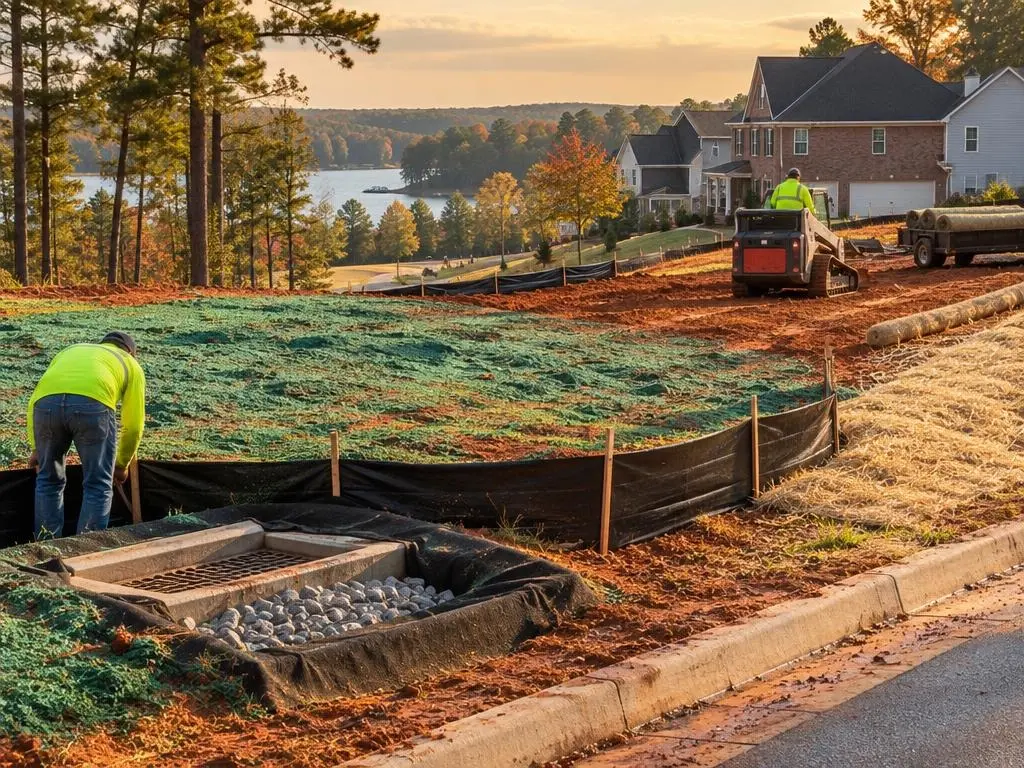
Hydroseeding in Fort Mill means working with Cecil soil, the most common soil series in town. USDA describes Cecil as a very deep, well-drained Piedmont soil with a sandy loam surface over a red clay subsoil. When a builder grades a lot, that thin sandy loam is often scraped off or buried, and the red clay ends up on top. Grass can grow in it, but it needs help.
Why the clay matters
Cecil's surface layer lets water in fairly well, but the clay subsoil is much slower. Medium surface runoff is normal. On a graded lot with clay at the surface, rain sheets off and carries seed with it unless the seed is anchored. Hydroseeding puts seed, fertilizer and fiber mulch with tackifier on in one layer, which holds far better than loose straw.
Our prep on Fort Mill lots
- Loosen packed clay so roots can get in
- Add topsoil where the original surface is gone
- Fine grade so runoff heads toward the street
- Lime and fertilize based on a soil test
- Hydroseed and set a watering schedule
Explosive growth
Fort Mill grew from 10,811 people in 2010 to 24,521 in 2020, an increase of 126.8 percent, and a 2008 annexation doubled the town's physical size. After the textile mills shut down, the town became a major Charlotte suburb. That means a lot of new subdivisions, new schools and new commercial space, all needing silt fence during construction and permanent seeding at the end.
Weather to plan around
Fort Mill has a humid subtropical climate with thunderstorm-prone summers and rainy winters with occasional sleet and snow. Summer storms can wash fresh seed off clay quickly, so on slopes and in swales we add erosion control blankets. Early fall is our preferred window for fescue lawns here.
Open space nearby
The Anne Springs Close Greenway covers about 2,300 acres of lakes, forests and pastures. Homes near its edges often have wooded borders and shade, which affects seed choice.
Get a free estimate or call (704) 387-5959.
Fort Mill Soil and Growth
- Cecil series. Cecil is the most common soil in Fort Mill: very deep and well drained, with a sandy loam surface over red clay subsoil.
- Runoff. USDA describes Cecil soils as having medium surface runoff and moderately high permeability at the surface but slower in the clay.
- Rapid growth. Population rose 126.8 percent between 2010 and 2020, and a 2008 annexation doubled the town's area.
- Large greenway. The Anne Springs Close Greenway covers about 2,300 acres of lakes, forests and pastures.
Fort Mill Questions
My new yard is solid red clay. Can hydroseed grow in it?
Yes, with prep. Loosening the clay, adding some topsoil and liming based on a soil test make a big difference.
Why does seed wash off my yard after storms?
Clay sheds water fast. Hydromulch with tackifier anchors the seed, and blankets help on slopes and in swales.
Which months suit seeding a fescue lawn in Fort Mill?
Early fall. Late spring and early summer suit Bermuda instead.
Do you work on South Carolina construction sites?
Yes. On York County projects we put up silt fence, protect storm inlets and hydroseed for permanent cover.
Hydroseeding Near Fort Mill
- Hydroseeding in Charlotte, NC
- Hydroseeding in Matthews, NC
- Hydroseeding in Mint Hill, NC
- Hydroseeding in Huntersville, NC
- Hydroseeding in Cornelius, NC
- Hydroseeding in Davidson, NC
- Hydroseeding in Mooresville, NC
- Hydroseeding in Concord, NC
- Hydroseeding in Harrisburg, NC
- Hydroseeding in Kannapolis, NC
- Hydroseeding in Gastonia, NC
- Hydroseeding in Belmont, NC
- Hydroseeding in Mount Holly, NC
- Hydroseeding in Cramerton, NC
- Hydroseeding in Indian Trail, NC
- Hydroseeding in Stallings, NC
- Hydroseeding in Pineville, NC
- Hydroseeding in Waxhaw, NC
- Hydroseeding in Monroe, NC
- Hydroseeding in Rock Hill, SC
- Hydroseeding in Tega Cay, SC
- Hydroseeding in Lake Wylie, SC
- Hydroseeding in Clover, SC