
Queen City lawns and slopes
Hydroseeding in Charlotte, NC
Seed, mulch and erosion control sprayed onto Piedmont clay, timed to Charlotte's fescue and bermuda seasons.
- No-charge site walk and a written quote
- Seed mix chosen for your sun, shade and the season
- Grading, silt fence and seed on one schedule
Getting Grass to Hold on Charlotte Clay
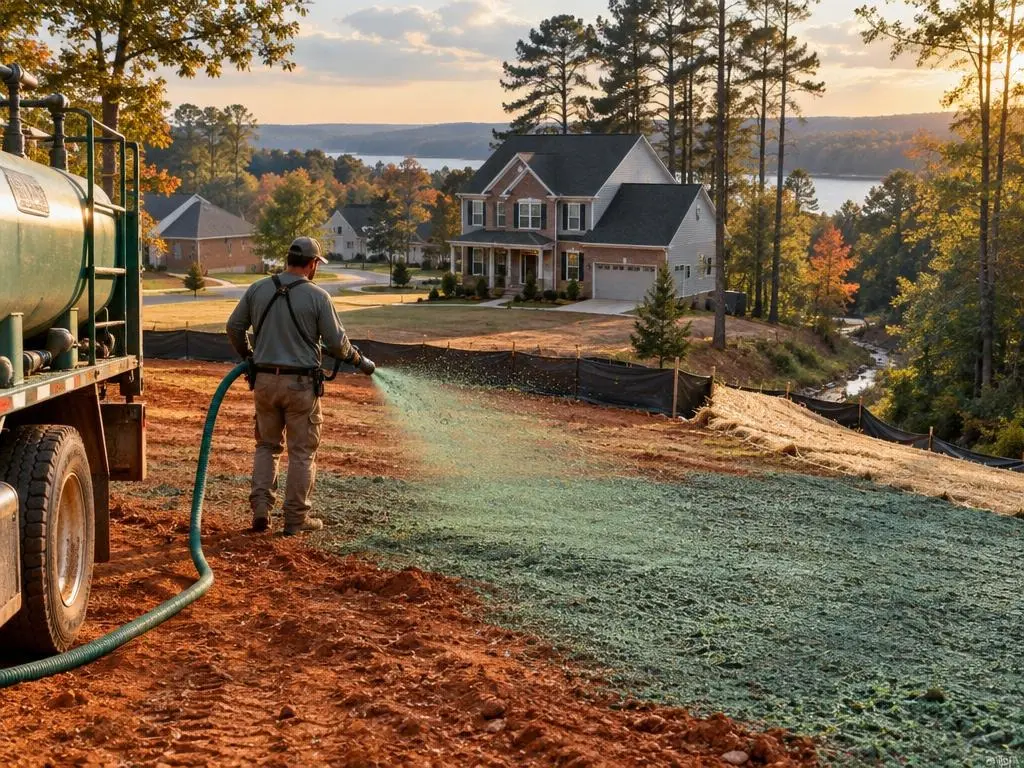
Hydroseeding in Charlotte works because it answers the two problems every bare lot here has: red clay that sheds water and rain that shows up all year. We spray a slurry of seed, fertilizer, wood fiber mulch and tackifier onto prepared soil in one pass. The fiber keeps the seed damp, and the tackifier binds the whole layer to the clay, so the seed stays where it landed instead of riding the first thunderstorm into the street. For new construction lawns, regraded yards, banks along a driveway and builder lots waiting on a certificate of occupancy, hydro seeding is usually the quickest way to get living cover on dirt.
What is under a Charlotte yard
Charlotte covers most of Mecklenburg County in the Carolina Piedmont, and the soil that defines this region is the Cecil series, which North Carolina adopted as its state soil. A typical Cecil profile has roughly 2 to 8 inches of brown sandy loam on top and red kaolinite clay below, flecked with mica. That clay is fine for building on, which is one reason the region has grown so fast, but it has little ability to recover from compaction. After a few passes of a loader or a concrete truck, the subsoil on a new lot can be as tight as a driveway. Many older fields and lots also lost their topsoil to erosion decades ago, leaving the red clay at the surface. Seed sprayed on that clay without loosening it will sprout and then struggle, because the roots cannot get down and water runs off instead of soaking in.
So before we spray, we look at what is actually there. On graded new-build lots we usually rip or till the compacted layer, rake out rock and construction debris, and bring in or spread topsoil where the builder stripped it. On older lawns along the tree-lined streets of neighborhoods like Myers Park or Dilworth, the problem is more often shade from mature trees and years of foot traffic than a lack of soil. The prep is different, and so is the seed.
Rain, heat and the seeding calendar
Charlotte has a humid subtropical climate with four real seasons. NOAA normals for the airport give a January daily high around 52 degrees and a July high just over 90, with an average of 44 days a year at 90 or above. Freezing nights usually fall between early November and late March, which leaves a growing season of about 220 days. Precipitation averages 43.60 inches a year and is spread evenly; August is the wettest month on the normals table, and October has the fewest days with measurable rain.
That calendar sets our seeding windows. Most Charlotte lawns are tall fescue, a cool-season grass that stays green much of the year and handles partial shade. NC State Extension puts the Piedmont window for seeding thin fescue lawns at September 1 to October 1, as nights cool off. October's fewer rainy days also give a fresh slurry a better chance to set before a downpour. Fescue sprayed in June faces a summer of heat and humidity, and NC State notes the grass is highly susceptible to brown patch when it is humid and above 85 degrees. Bermudagrass, the warm-season option for full-sun yards, works the other way around. Common bermudagrass can be grown from seed, and NC State's calendar starts bermuda planting in late May, once soil is warm. Hybrid bermudas such as Tifway are sod or sprig only.
Sod, hydroseed or dry seed?
All three have a place here. Sod gives you a finished lawn the day it goes down, and it costs the most: HomeGuide's range for laying sod is $1 to $4 a square foot, against $0.12 to $0.35 for hydroseeding. Dry broadcast seed is cheapest, but on a sloped clay yard the seed and straw tend to wash into the low corner after the first hard rain. University of Nebraska Extension sums up the tradeoff plainly: hydroseeding runs slightly above dry seeding in cost and usually below sod, and hydroseeded grass usually shows in 5 to 7 days, where dry seed takes two to three weeks to appear. For a large new lawn, a bank or a builder lot, hydroseed usually lands in the middle on price and ahead on coverage. For a small, shady patch by the back door, sod or hand seeding may make more sense, and we will say so.
Rules for bare ground
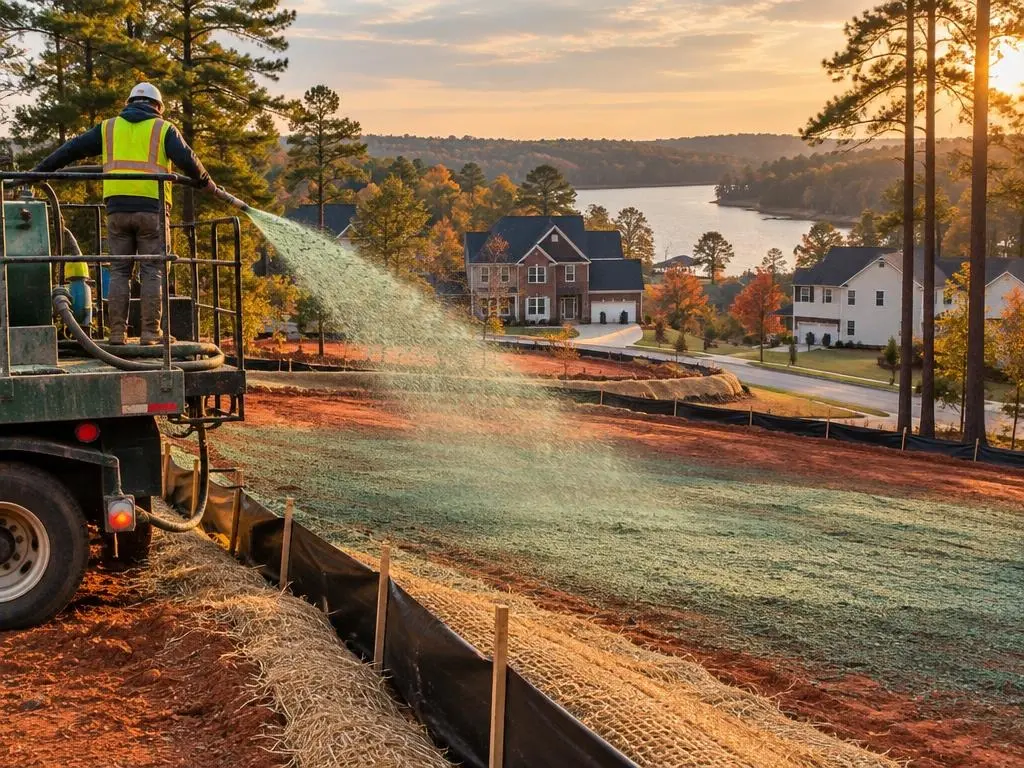
North Carolina's Sedimentation Pollution Control Act covers land-disturbing work of any size and requires that erosion and sediment control measures keep sediment on the site. State rules say graded slopes must be vegetated or otherwise stabilized within 21 calendar days of finishing a phase of grading. Projects disturbing more than an acre need an approved erosion and sedimentation control plan before work starts, and local programs can be stricter than the state. That is why builders call us for silt fence on day one and for hydroseed or erosion control blankets as soon as the final grade is set. For a homeowner regrading a backyard, the same principle applies on a smaller scale: get cover on the dirt fast, and keep the mud out of the storm drain.
Where we start
Every job begins with a site visit. We measure, check the slope and drainage, look at sun and shade, and tell you which seed, mulch and prep make sense for the ground you have and the time of year. Get a free estimate The written estimate spells out each item, so you can compare it line by line with any other hydroseeding company you talk to.
After the spray
The slurry dries to a green crust within a day. From there the job is water. For roughly the first three weeks, keep the surface from ever drying out, which on a hot Charlotte afternoon can mean short sprinkler runs morning, midday and late afternoon. On clay, NC State's advice for established lawns applies early too: water until it starts to run off, let it soak in, then water again. Most fescue lawns are ready for a first mow after about four to six weeks. We leave a written watering and mowing plan with every new lawn so nothing is guesswork.
Why Homeowners Call Hydroseeding Charlotte
We look at the soil first
A compacted red clay lot and a shady lawn under old oaks need different prep. We decide after seeing the ground, not from an address.
Seed timed to the grass
Fescue goes down in the fall window and bermuda in late spring. If the timing is wrong for your grass, we tell you and suggest temporary cover.
Erosion control built in
Banks, swales and ditches get blankets or heavier mulch where a plain spray would wash. Silt fence and inlet protection are part of the same plan.
Line-item estimates
Prep, topsoil, seed mix, mulch, blankets and fence are listed separately, so you know what you are paying for.
Common Questions
Is hydroseeding good for lawns?
Yes, for most new lawns and large bare areas. The mulch keeps the seed moist and the tackifier holds it on slopes, and with warm soil and steady moisture you can usually spot sprouts within 5 to 7 days. It works best when the soil underneath is loosened and the lawn is watered faithfully for the first few weeks.
What is the best type of grass for a lawn in Charlotte, NC?
For most yards with some shade, a turf-type tall fescue blend. It stays green much of the year and tolerates shade, but it needs fall seeding and can get brown patch in hot, humid summers. For full sun and heavy wear, common bermudagrass seeded in late spring is the tougher choice, though it goes tan in winter.
Is hydroseeding or sod better for erosion control in Charlotte?
Sod covers the ground instantly, so on a small, steep spot it can stop washing right away. For larger banks and graded lots, hydroseed with heavy mulch or an erosion control blanket underneath covers more ground for the money and roots in well. We often use both on one job: sod or blankets in the swale, hydroseed on the rest.
Which months suit hydroseeding a Charlotte lawn?
Early fall for tall fescue, roughly September into early October, and late spring into early summer for bermudagrass. Outside those windows we can still stabilize bare dirt with mulch and a temporary cover crop, then seed the permanent grass when the season turns.
How soon after grading does the ground need to be covered?
Under North Carolina rules, graded slopes need to be vegetated or otherwise stabilized within 21 calendar days after a phase of grading is done, and local programs can set tighter deadlines. In practice, the sooner the better, because a single summer storm can cut rills in fresh clay.
Can you hydroseed straight onto red clay?
We can, but we rarely recommend it without prep. Compacted Piedmont clay sheds water and blocks roots, so we loosen it, add topsoil or amendments where needed, and then spray. Grass on prepared clay roots deeper and needs less babysitting later.
How long before I can walk on or mow a hydroseeded lawn?
Keep foot traffic off until the grass is up and filling in. Expect the first cut somewhere around four to six weeks, when the blades reach roughly 4 inches, with the mower set high.
Towns Around the Queen City We Cover
We work in Charlotte proper, from older neighborhoods near Uptown out to Ballantyne, Steele Creek and University City, and in the towns around it: Matthews, Mint Hill, Huntersville, Cornelius, Davidson, Mooresville, Concord, Harrisburg, Kannapolis, Gastonia, Belmont, Mount Holly, Cramerton, Indian Trail, Stallings, Pineville, Waxhaw, Monroe, Fort Mill, Rock Hill, Tega Cay, Lake Wylie and Clover. The ground changes as you go. Lake Norman towns like Cornelius, Davidson and Mooresville have shoreline banks and drainages that feed drinking-water lakes. Concord, Harrisburg and Kannapolis add fast-growing subdivisions on Rocky River tributaries. Gaston County towns such as Belmont, Mount Holly and Cramerton sit along the Catawba. Union County's Indian Trail, Stallings, Waxhaw and Monroe have seen farm fields turn into neighborhoods, and across the line in South Carolina, Fort Mill, Rock Hill, Tega Cay, Lake Wylie and Clover follow their own state's rules. Pick a town below for its soil, water and local rules.
- Hydroseeding in Charlotte, NC
- Hydroseeding in Matthews, NC
- Hydroseeding in Mint Hill, NC
- Hydroseeding in Huntersville, NC
- Hydroseeding in Cornelius, NC
- Hydroseeding in Davidson, NC
- Hydroseeding in Mooresville, NC
- Hydroseeding in Concord, NC
- Hydroseeding in Harrisburg, NC
- Hydroseeding in Kannapolis, NC
- Hydroseeding in Gastonia, NC
- Hydroseeding in Belmont, NC
- Hydroseeding in Mount Holly, NC
- Hydroseeding in Cramerton, NC
- Hydroseeding in Indian Trail, NC
- Hydroseeding in Stallings, NC
- Hydroseeding in Pineville, NC
- Hydroseeding in Waxhaw, NC
- Hydroseeding in Monroe, NC
- Hydroseeding in Fort Mill, SC
- Hydroseeding in Rock Hill, SC
- Hydroseeding in Tega Cay, SC
- Hydroseeding in Lake Wylie, SC
- Hydroseeding in Clover, SC
Our Services
Six kinds of seed, soil and erosion work for Charlotte homeowners, builders and site managers.
Residential Lawn Hydroseeding
New lawns sprayed onto prepared soil for new homes, regraded yards and worn-out lawns starting over.
Learn more →Commercial & Jobsite Hydroseeding
Hydroseeding for builders, developers and property managers who need permanent cover and a passed inspection.
Learn more →Slope & Swale Erosion Control
Blankets, heavy hydromulch or BFM on Charlotte clay banks, drainage swales and ditch lines that won't hold seed.
Learn more →Silt Fence & Sediment Control
Silt fence installation, inlet protection and repairs that keep mud on the site and off the street.
Learn more →Yard Grading & Dirt Work
Yard grading, topsoil and dirt work that get the ground right before seed goes down.
Learn more →Overseeding & Lawn Repair
Overseeding, aeration and lawn repair for thin fescue, bare patches and storm-damaged yards.
Learn more →Have Bare Dirt in Charlotte? Let's Cover It
We come out to look at the ground for free, in Charlotte and the nearby towns. Call (704) 387-5959 or send the form.