
Stop the washing
Slope & Swale Erosion Control in Charlotte, NC
Blankets, heavy mulch and seed for banks, channels and ditches where a plain spray will not hold.
- No-charge site walk and a written quote
- Seed mix chosen for your sun, shade and the season
- Grading, silt fence and seed on one schedule
When Rain Keeps Carving the Same Bank
Slope and swale erosion control is the work we do where water moves fast enough to strip seed off the ground: steep banks behind houses, cut slopes along driveways, drainage swales between lots, roadside ditches and pond edges. Around Charlotte, red clay and year-round rain make these the spots that fail first. Our erosion control services pair seed with something stronger than standard mulch, whether that is an erosion control blanket, a heavier-rate hydromulch, or bonded fiber matrix, so the ground holds while the grass roots in.
How erosion starts on Piedmont clay
NC DEQ describes four types of erosion on exposed ground: splash, sheet, rill and gully, and stream or channel erosion. On a Charlotte slope you can usually watch them happen in order. Raindrops knock clay particles loose, thin sheets of water carry them off, the flow concentrates into small rills, and within a few storms those rills become gullies. Clay subsoil is especially prone because water soaks in slowly and runs off quickly. The topsoil goes first, and as DEQ points out, that is the nutrient-rich layer the grass needed.
The sediment does not just disappear. It ends up on neighbors' yards, in the street, in storm drains and eventually in creeks. Mecklenburg County's major waters include the Catawba River, Lake Norman, Mountain Island Lake and the Rocky River. Keeping soil on your slope is about your yard first, but it also keeps the mud out of those waters.
Matching the treatment to the slope
Not every bank needs the same thing. Here is how we usually decide.
- Gentle slopes and short banks. Standard hydroseed with extra wood fiber mulch and tackifier often holds, especially when sprayed in two directions.
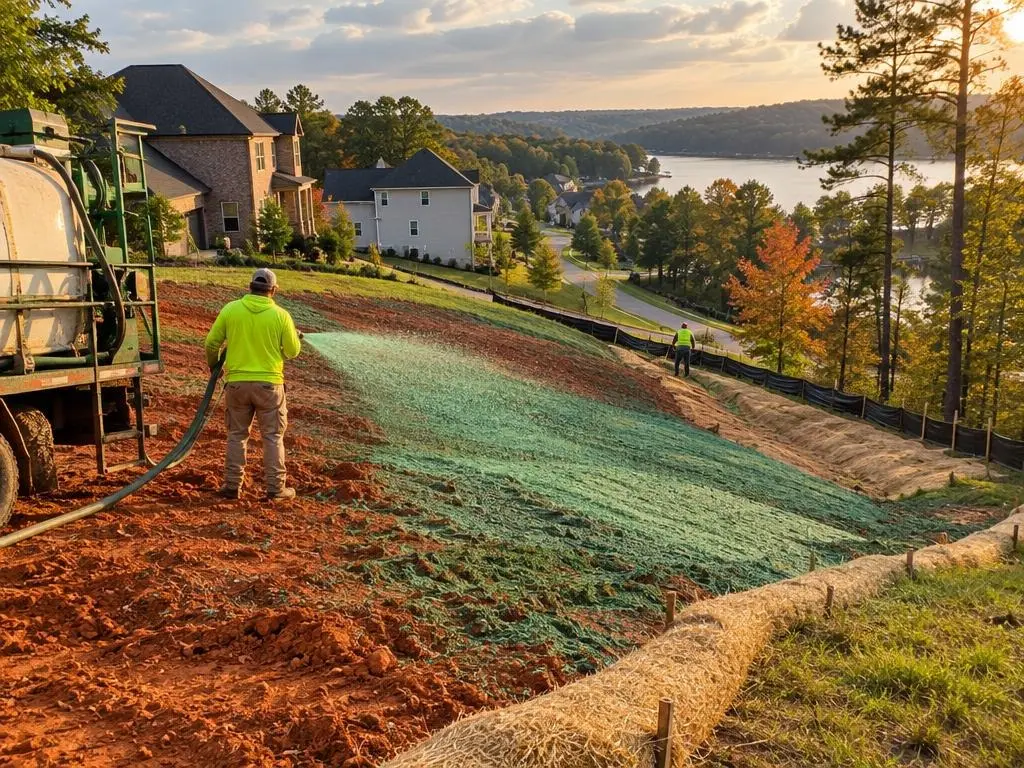
- Steeper slopes and long runs. Hydromulch at heavier rates, or a bonded fiber matrix, forms a tougher mat that resists rill erosion. BFM bonds fibers together with a stronger tackifier and stays put through hard rain better than standard mulch.
- Swales, ditches and channels. Concentrated flow will scour a spray-on product. These get erosion control blankets, either straw or straw and coconut, stapled into a seeded and fertilized bed, or coir blankets where flow is stronger.
- The steepest cuts and outfalls. Where vegetation alone will not hold, we talk with you or your engineer about matting, rock or other measures, and do not pretend grass is enough.
Straw blankets vs hydromulch
Erosion control blankets are rolls of straw, coconut fiber or a mix held in netting. Laid over seed, they protect the surface from raindrop impact and flowing water right away, and the seed grows up through them. They cost more than spray-on mulch and take more labor to install, but in a swale they are often the only thing that works. Hydromulch and BFM are faster to apply over large slopes and follow uneven ground without seams. On many Charlotte jobs we use both: blankets in the channel, heavier hydromulch on the faces above it.
Rules that apply
For construction sites, North Carolina rules say cut and fill slopes must be no steeper than what can be properly stabilized and must be vegetated or otherwise stabilized within 21 calendar days of finishing a phase of grading. Erosion control measures are designed for the peak runoff from a 10-year storm, and a 25-year storm in high-quality waters. Along natural watercourses and lakes, a buffer must be kept that contains visible sediment in the part of the buffer nearest the disturbed area. If you are a homeowner fixing a backyard bank, those rules may not apply to you directly, but they reflect what it takes for a slope to survive Charlotte weather.
Timing and storms
There is no off season for erosion here. August is the wettest month on Charlotte's normals, and summer thunderstorms dump water fast. NC DEQ even publishes hurricane-season guidance for construction sites. Its advice for sites with a big storm coming is to stop opening new ground that cannot be stabilized in time and to secure what is already exposed. We follow the same thinking: if a slope is bare and the seed window is weeks away, we cover it now with blankets or heavy mulch and a temporary crop, and come back for permanent seed when the season allows. Get a free estimate
Upstream causes
A lot of the washed banks we see around Charlotte are not slope problems at all; they are water problems. A downspout dumps a roof's worth of rain at the top of the bank, a neighbor's regrade sends sheet flow across the property line, or a driveway funnels runoff to one corner. Seed and blankets will not survive that. Before we price any erosion control work, we trace where the water is coming from and include the fix, whether it is a downspout extension, a small berm or a swale, so the treatment on the slope is not fighting a firehose.
What to expect after
Slopes take longer to fill in than flat ground, because water runs off before it soaks in. Water slowly and in short cycles. Check after the first few heavy rains for any spot where water is undercutting a blanket or cutting a rill through mulch. Those small fixes are cheap if caught early, and we would rather come back and patch one than have you rebuild a bank.
Erosion Control Options
We pick the lightest treatment that will actually hold.
Erosion control blankets
Straw, straw-coconut or coir blankets stapled over seed in swales and on steep faces.
Hydromulch
Wood fiber mulch with tackifier at heavier rates for long or steep slopes.
Bonded fiber matrix
A tougher spray-on mat for slopes that standard mulch will not hold.
Slope stabilization seeding
Seed and fertilizer chosen for a bank that will not be mowed often.
Swale and ditch lining
Shaping, seeding and blanketing drainage channels that carry concentrated flow.
Temporary cover
Mulch and quick-growing cover on bare slopes until the permanent seed window.
Erosion Control Price Ranges
| Item | Published range |
|---|---|
| Wood-fiber hydraulic mulch per 1,000 sq ft (DOT 2025 erosion unit costs) | $98 |
| Blanket of 70/30 straw and coconut per 1,000 sq ft (same DOT list) | $468 |
| Coir-only blanket per 1,000 sq ft (same DOT list) | $532 |
| Steep slope surcharge on residential hydroseeding, per sq ft (HomeGuide) | add $0.05 to $0.10 |
| Bonded fiber matrix | Quoted on site |
Published ranges for reference. Our itemized quote replaces them for your job. Slope, access and soil vary by site, so we price it on location. The DOT figures are public agency rates, listed for scale only.
How We Stabilize a Slope
1. Read the water
We find where runoff enters, concentrates and leaves the slope.
2. Fix the shape
Rills are filled, the face is smoothed and the toe and top are graded to shed water evenly.
3. Seed and feed
Seed and fertilizer go down on a loosened surface.
4. Cover
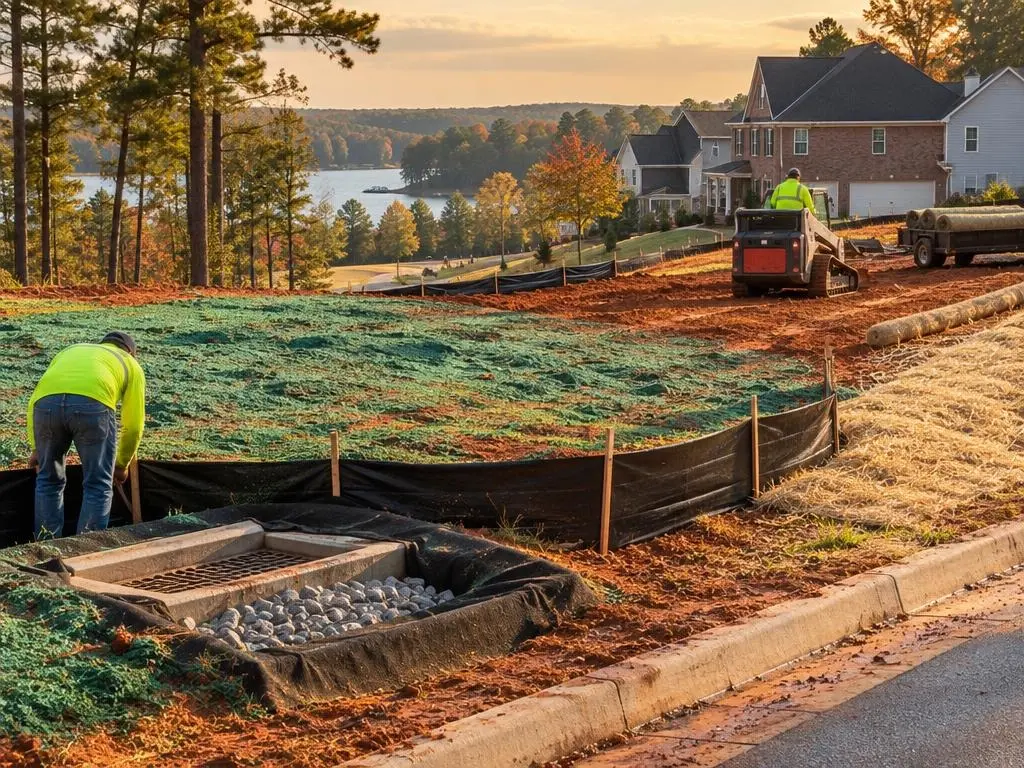
Blankets in channels and steep spots, hydromulch or BFM on the faces.
5. Check after storms
We look at it after the first heavy rains and patch anything that moved.
Why Choose Us for Slope & Swale Erosion Control
Right product per zone
Swales, faces and toes get different treatments instead of one spray for everything.
Shape before seed
We fix gullies and grade first, since seed cannot fix a slope that concentrates water.
Straight answers
If a slope needs rock or an engineer, we say so rather than sell more mulch.
Slope & Swale Erosion Control Questions
Are erosion control blankets worth the cost on a backyard slope?
In swales and on steep faces, usually yes. Blankets protect the soil from the first storm onward, while spray-on mulch can wash in concentrated flow. On gentle slopes, heavier hydromulch is often enough.
What is bonded fiber matrix?
A spray-on erosion control product where wood fibers are bound with a stronger tackifier, forming a continuous mat. It holds better than standard hydromulch on steep ground and does not need stapling like a blanket.
Do the blankets have to be removed later?
Most straw and coconut blankets rot away gradually while the new turf roots through them. We will tell you which product we are using and what to expect from it.
Can you fix a gully that is already a foot deep?
Yes. We fill and compact it, regrade the slope so water spreads out, then seed and blanket it. If water is coming from a downspout or a neighbor's lot, we deal with that first or the gully will come back.
Slope & Swale Erosion Control Service Areas
- Hydroseeding in Charlotte, NC
- Hydroseeding in Matthews, NC
- Hydroseeding in Mint Hill, NC
- Hydroseeding in Huntersville, NC
- Hydroseeding in Cornelius, NC
- Hydroseeding in Davidson, NC
- Hydroseeding in Mooresville, NC
- Hydroseeding in Concord, NC
- Hydroseeding in Harrisburg, NC
- Hydroseeding in Kannapolis, NC
- Hydroseeding in Gastonia, NC
- Hydroseeding in Belmont, NC
- Hydroseeding in Mount Holly, NC
- Hydroseeding in Cramerton, NC
- Hydroseeding in Indian Trail, NC
- Hydroseeding in Stallings, NC
- Hydroseeding in Pineville, NC
- Hydroseeding in Waxhaw, NC
- Hydroseeding in Monroe, NC
- Hydroseeding in Fort Mill, SC
- Hydroseeding in Rock Hill, SC
- Hydroseeding in Tega Cay, SC
- Hydroseeding in Lake Wylie, SC
- Hydroseeding in Clover, SC
Get a Slope & Swale Erosion Control Estimate
Send a photo of the slope and we will set up a visit.